
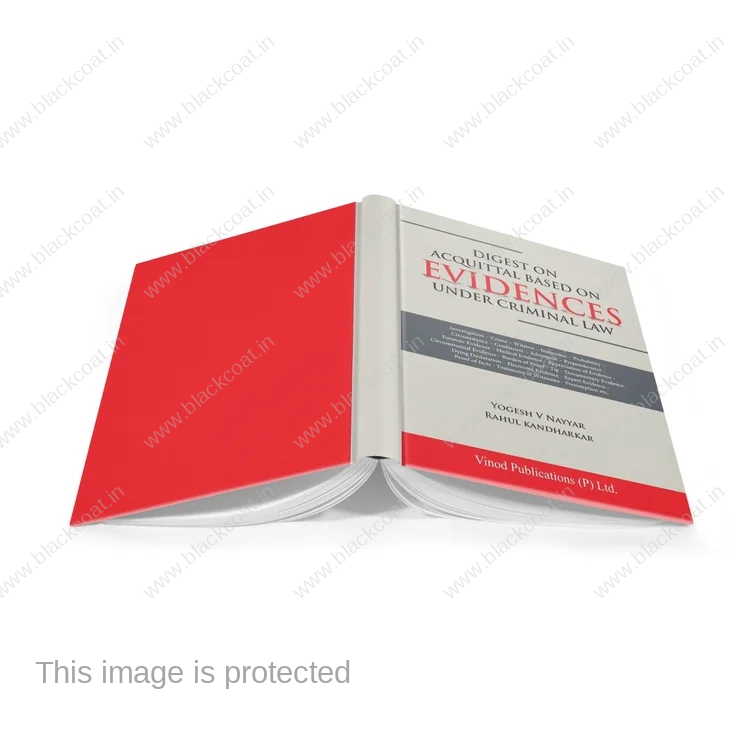
Yogesh V Nayyar & Rahul Kandharkar’s Digest on Acquittal Based on Evidences under Criminal Law
₹1,980.00 Original price was: ₹1,980.00.₹1,584.00Current price is: ₹1,584.00.
Author : Yogesh V Nayyar & Rahul Kandharkar
Publisher : Vinod Publication Pvt. Ltd.
ISBN No : 978-9395939034
SKU : BCVPP0071
Edition : 2024
Format : Hardbound
Pages : 996
HSN No : 49011010
Country Region : India
Description
In the 15th Century, an acquittal referred to the payment of a debt, but now it means being freed of charges against you in court. In fact, now the word is really used only in a legal sense. It’s from the Latin ad “to” plus quitare meaning “set free.” Getting an acquittal is still like being set free.
Criminal jurisprudence developed in this country recognizes that the eye sight capacity of those who live in rural areas is far better than compared to the town folks. Identification at night between known persons is acknowledged to be possible by voice, silhouette, shadow, and gait also as observed by Hon’ble Supreme Court of India in Pruthviraj Jayantibhai Vanol o. Dinesh Dayabhai Vala, 2021 SCC OnLine SC 493 and while in Pawan Kumar Chourasia us State of Bihar, 2023 LiveLaw (SC) 197, held that “Extra-judicial confession & its evidentiary value – Generally, is a weak piece of evidence”.
What’s important to be understood and gathered by a Criminal Lawyer is what plea or defense should be raised before the Court; which goes unshaken and the Court is bound to deliver a judgment of acquittal.
What Is a Criminal Defense?
Criminal defense is a strategic argument that attempts to challenge the validity and sufficiency of the prosecution’s evidence. The prosecution often referred to as the state, the people, for crimes, is the party trying to prove the criminal charges against an offender. The prosecution must prove the crime beyond a reasonable doubt.
Common Defenses to Criminal Charges:
There are many common defenses to criminal charges. An accused may argue that there are holes in the prosecution’s case, that evidence was gathered in violation of the accused’s constitutional rights, that another individual committed the crime, that the accused had a justifiable reason for committing the crime, that the defendant lacked the intent/motive to commit the crime, or that that defendant had a mental incapacity which caused him or her to commit the crime.
While some defenses are merely raised with the aim of showing that the prosecution has failed to make its case, other defenses are affirmative defenses, meaning they must be independently proven. So, what are the major criminal law defenses?
Innocence, Constitutional Violations, Alibi, Insanity, Self-Defense, Defense-of-Others, Defense-of-Property, Involuntary Intoxication, Voluntary Intoxication, Mistake of Law / Mistake of Fact, Duress or Coercion, Abandonment / Withdrawal, Necessity, Consent, Entrapment, Age Affecting Criminal Responsibility, Statute of Limitations.
The book in hand is a guide and compilation of case-laws and is written with a motive to procure acquittal placing reliance on the judgments and defenses taken therein; wherein the Hon’ble Supreme Court and High Courts delivered judgments acquitting the offenders; on the founding of preposition of Indian Evidence Act, Code of Criminal Procedure and ingredients of specific offence.



Reviews
There are no reviews yet.