
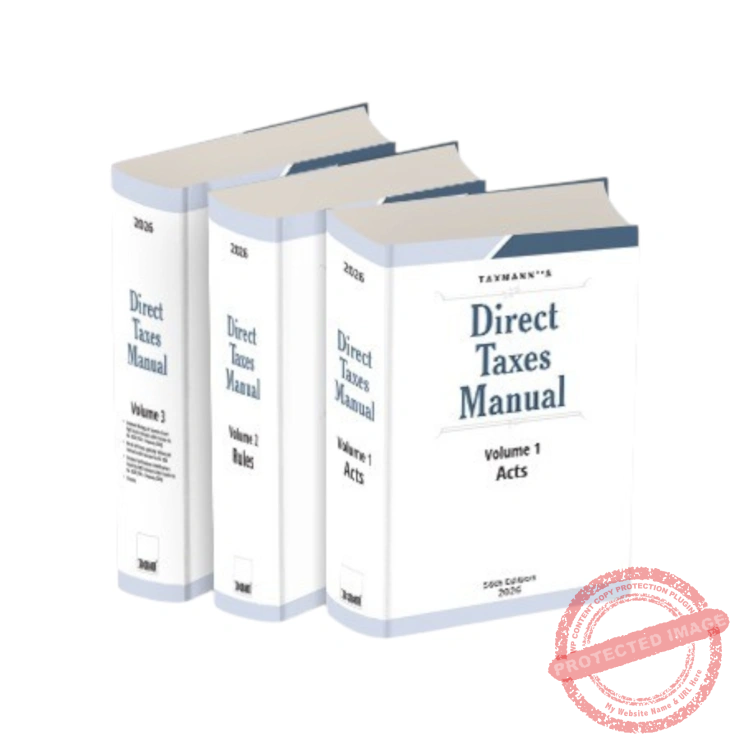
Taxmann’s Direct Taxes Manual (In 3 Volumes)
₹8,725.00 Original price was: ₹8,725.00.₹7,853.00Current price is: ₹7,853.00.
Author : Taxmann
Publisher : Taxmann
ISBN NO : 978-9375619420
SKU : BCTXM0061
Edition : 56th Edition, 2026
Format : Hardbound
Volumes : In 3 Volumes
HSN No : 49011010
Description
Direct Taxes Manual is the most exhaustive statutory reference compilation in Indian direct taxation—a work that has maintained its position as the authoritative practitioner’s desk set for 56 consecutive annual editions. The 2026 Edition arrives at the most consequential juncture in post-independence Indian tax history: the full transition from the Income-tax Act 1961 to the Income-tax Act 2025 (Act No. 30 of 2025).
Volume 1 presents the ITA 2025—a restructured, 536-section, 23-chapter statute with 15 Schedules—as its primary legislative text, fully amended by the Finance Act 2026. The 1961 Act has been preserved in the fabric of this Edition through the most elaborate bi-directional cross-reference architecture—mapping every section, every rule, and every form between the two regimes. The Finance Act 2026 is reproduced in full and amends both the Income-tax Act 1961 (for the assessment year commencing 1 April 2026) and the Income-tax Act 2025 (for the tax year commencing 1 April 2026 onwards)—a dual-regime enactment. Volume 2 reproduces the Income-tax Rules 2026 (the new procedural code, incorporating G.S.R. No. 198(E) dated 20 March 2026) alongside 27 additional divisions of subordinate legislation, procedural schemes, and tax administration frameworks. Volume 3 compiles over a century of judicial precedent (1922–February 2026), six decades of CBDT administrative guidance (1961–February 2026), and a comprehensive lexicon of judicially interpreted statutory terms—all re-indexed section-by-section against the Income-tax Act 2025.
This book is intended for the following audience:
Chartered Accountants and Tax Consultants for current-year compliance under the ITA 2025 (new tax regime, capital gains, TDS/TCS under Chapter XIX, return filing under Chapter XV) alongside legacy 1961 Act assessments, with the cross-reference tables providing instant transitional navigation
Advocates and Litigation Specialists for High Court and Supreme Court work, where access to 104 years of judicial digests (1922–February 2026) mapped against 2025 Act sections, and the judicially defined words and phrases compilation, are primary reference tools
Corporate Tax and Transfer Pricing Teams for transfer pricing compliance under Chapter X (Sections 161–173, including APA procedures and safe harbour rules), ICDS application, MAT/AMT under Chapter XIII, and IFSC-related exemptions under Schedule VI
Non-Profit Organisations and Their Advisors for the new, expanded NPO regime under Chapter XVII (Sections 332–355) covering registration, corpus donation, accumulated income, taxable regular income, switching between regimes, and the complete commercial activities framework
Government Tax Officers (IRS/CBDT) for the full text of all faceless proceedings schemes, the complete CBDT circular archive, and the administrative provisions of Chapters XIV–XVI
Financial Institutions and Banks for TDS/TCS under the comprehensive Chapter XIX (Sections 392–402, covering salary TDS, 80+ categories of TDS under Section 393, TCS under Section 394), ICDS compliance (Division 2, Volume 2), and recognised provident/superannuation fund rules under Schedule XI
Law Faculty and Tax Researchers for the most complete single-source judicial record of Indian income tax law across a 100-year arc
The Present Publication is the 56th Edition | 2026, edited by Taxmann’s Editorial Board, with the following noteworthy features:
[Income-tax Act 2025—First Edition as Primary Statute] The 56th Edition is the first to present the Income-tax Act 2025 (Act No. 30 of 2025) as the primary statute, fully amended by the Finance Act 2026. The text includes a chapter-wise arrangement of sections, editorial footnotes cross-referring every provision to its 1961 Act counterpart, an Allied Laws Appendix reproducing all allied statutes and regulations cited within the Act (including Companies Act 2013 Schedule III, PMLA, SEBI Regulations), and a comprehensive subject index
[Finance Act 2026—Both Regimes Covered] The complete text of the Finance Act 2026 is reproduced, covering amendments to both the Income-tax Act 1961 (Part A: Sections 4–34, for AY 2026-27) and the Income-tax Act 2025 (Part B: Sections 35–158, for tax year 2026-27 onwards), along with Chapter VI (Miscellaneous) and the First Schedule (tax rates)
[Bi-Directional Cross-Reference Tables—Acts, Rules, and Forms] Six exhaustive cross-reference tables are placed at the front of Volumes 1 and 2.
Volume 1 carries two bi-directional section concordances (ITA 1961 ↔ ITA 2025)
Volume 2 carries four tables covering bi-directional rule mappings (IT Rules 1962 ↔ IT Rules 2026) and bi-directional form mappings (IT Forms 1962 ↔ IT Forms 2026)—each with headings reproduced on both sides
These tables are the primary transitional navigation tool for practitioners working across both regimes simultaneously
[Income-tax Rules 2026—Complete Text with Computational Illustrations] The full text of the Income-tax Rules 2026 (incorporating G.S.R. No. 198(E) dated 20-03-2026) is reproduced with an arrangement of rules, detailed computational illustrations—including Rule 81’s TNMM weighted average PLI calculations with multi-year tabular comparables for transfer pricing—an Allied Laws Appendix, and a subject index
[Landmark Rulings of Supreme Court and High Courts (1922–February 2026)] Volume 3 compiles over a century of direct tax judicial precedent, systematically re-indexed section-by-section against the Income-tax Act 2025 with corresponding 1961 Act section references in brackets. Entries are substantive digests, not bare citations. Coverage spans foundational interpretive questions (accrue/arise/receive under Section 5; control and management under Section 6) to capital gains issues (stamp duty valuation and DVO jurisdiction under Section 78; residential house exemption under Section 82) and includes 2024–2025 Supreme Court decisions. Both a section-key and alphabetical key are provided
[Words and Phrases Judicially Defined—Cross-Indexed to the 2025 Act] A dedicated compilation in Volume 3 presents every significant statutory term that has been judicially interpreted—’business,’ ‘trade,’ ‘adventure,’ ‘accrue,’ ‘arise,’ ‘agricultural income,’ ‘control and management,’ ‘amalgamation,’ and others—with structured digests of the relevant Supreme Court and High Court rulings. All entries carry both the 2025 Act section reference and the corresponding 1961 Act section, and the compilation is navigable through a section-key and an alphabetical key
[CBDT Circulars, Clarifications and Notifications (1961–February 2026)] The complete archive of CBDT administrative guidance relevant under the Income-tax Act 2025—spanning six decades from 1961 to February 2026—is compiled in Volume 3, organised by section of the 2025 Act with 1961 Act section cross-references. Coverage includes TDS/TCS e-filing procedure circulars, bad debt write-off instructions (Instruction No. 17/2008), depreciation on hire-purchase assets, sector-specific notifications (NABARD, OIDB, NDDB, Credit Guarantee Fund Trust), and exemption-related notifications. Both a section-key and alphabetical key are provided
[28 Divisions of Subordinate Legislation in Volume 2] Volume 2 is organised into 28 self-contained divisions, each with arrangement of rules/paragraphs, full statutory text, and (where applicable) a subject index, covering the complete spectrum of direct tax procedural and administrative law—from the Income-tax Rules 2026 and ICDS, through all five faceless proceedings schemes (Faceless Assessment, Penalty, Appeal, Jurisdiction, and Inquiry/Valuation), e-Appeals, e-Advance Rulings, e-Dispute Resolution, ITAT Rules 1963, Capital Gains Accounts Scheme, DRP Rules, Certificate Proceedings Rules, savings-linked investment schemes, and more
[Foreign Assets of Small Taxpayers Disclosure Scheme 2026] Volume 1 reproduces the complete text of the newly introduced Foreign Assets of Small Taxpayers Disclosure Scheme 2026, making it immediately accessible to practitioners advising on its compliance window
[Direct Tax Vivad Se Vishwas Framework]
The full Vivad Se Vishwas framework is consolidated in Volume 1: the Scheme text, the Rules, and all relevant CBDT notifications and circulars—providing practitioners with the complete dispute settlement reference in one place
The volume-wise coverage of the book is as follows:
Volume 1 – Acts (1,468 Pages | As amended by Finance Act 2026)
Cross-reference Concordance Tables — ITA 1961 ↔ ITA 2025 (bi-directional, ~180 pages)
Income-tax Act 2025 (Act No. 30 of 2025) — 536 sections, 23 chapters, 15 Schedules; as amended by Finance Act, 2026; with editorial footnotes, Allied Laws Appendix, and subject index (~800 pages)
Finance Act 2026 — Complete text including rates for both Acts, all amendment sections (~90 pages)
Prohibition of Benami Property Transactions Act 1988 — As amended to date
Securities Transaction Tax Act — As amended by Finance Act 2026
Commodities Transaction Tax Act
Black Money (Undisclosed Foreign Income and Assets) and Imposition of Tax Act, 2015 — As amended by Finance Act 2026, with Black Money Rules 2015
Direct Tax Vivad Se Vishwas Scheme 2024 — Scheme, Rules, notifications/circulars
Foreign Assets of Small Taxpayers Disclosure Scheme 2026
Volume 2 – Rules (1,912 Pages | Incorporating G.S.R. No. 198(E), dated 20-03-2026)
Cross-reference Tables — IT Rules 1962 ↔ IT Rules 2026; IT Forms 1962 ↔ IT Forms 2026 (four bi-directional tables, ~200 pages)
28 Divisions of subordinate legislation, procedural schemes, and tax administration framework
Volume 3 – Judicial and Administrative Reference (1,746 Pages | Amended up to March 2026)
Division 1 — Schemes (14 schemes: ELSS, PPF, Sukanya Samriddhi, Kisan Vikas Patra, Mahila Samman Savings Certificate, Senior Citizens Savings, Income Tax Informants Rewards, Tax Return Preparer, Electoral Bond, Benami Adjudicating Authority Service Rules, Tonnage Tax Training Guidelines, AAR Appointment Rules, Income-tax Welfare Fund Rules, Hospitalisation Policy)
Division 2 — Words & Phrases Judicially Defined — Section-key, alphabetical-key, and full digests
Division 3 — CBDT Circulars, Clarifications & Notifications [1961–February 2026] — Section-key, alphabetical-key, and full texts
Division 4 — Landmark Rulings of SC/High Courts [1922–February 2026] — Section-key, alphabetical-key, and full digests
The structure of the book is as follows:
The three-volume set follows the natural hierarchy of legal authority: primary legislation (Volume 1) → subordinate legislation and procedural rules (Volume 2) → interpretive and administrative reference (Volume 3)
Within each volume, content is organised into numbered, self-contained divisions, each containing its own arrangement of sections, rules, full statutory text, and, where applicable, a subject index.
Editorial footnotes within the ITA 2025 text in Volume 1 actively cross-refer the reader to the corresponding Words & Phrases and CBDT Circular compilations in Volume 3
The bi-directional cross-reference tables (two for Acts in Volume 1; two for Rules and two for Forms in Volume 2) are the structural load-bearing instruments of the regime transition. They are positioned at the front of their respective volumes—signalling their operational primacy over commentary
A practitioner working on a legacy assessment under the 1961 Act can navigate instantly to the parallel provision in the 2025 Act, and vice versa, without leaving the set
No single volume is designed to function independently. The footnote architecture, cross-reference tables, and divisional structure are built as an integrated three-volume research tool



Reviews
There are no reviews yet.