
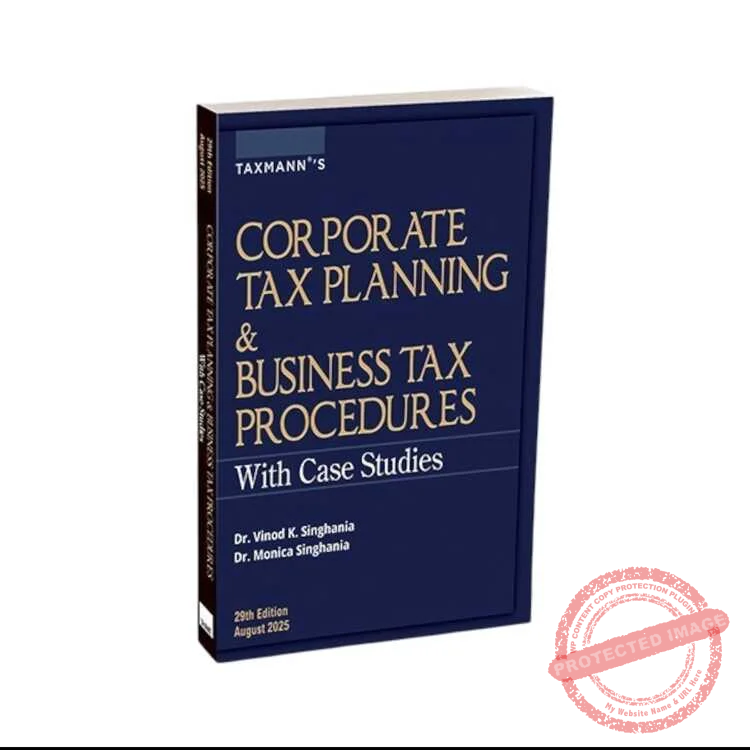
Vinod K. Singhania & Monica Singhania’s Corporate Tax Planning & Business Tax Procedures with Case Studies
₹1,445.00 Original price was: ₹1,445.00.₹1,301.00Current price is: ₹1,301.00.
Author : Vinod K. Singhania & Kapil Singhania
Publisher : Taxmann
ISBN NO : 978-9371265638
SKU : BCTXM0052
Edition : 29th Edition, 2025
Format : Paperback
Pages : 524
HSN No : 49011010
Description
Corporate Tax Planning & Business Tax Procedures with Case Studies is a comprehensive and authoritative treatise on corporate taxation, tax planning strategies, and business tax procedures in India. The book presents both the theoretical framework and practical applications of tax laws, supported by numerous case studies and multiple-choice problems. The work emphasises legitimate tax planning—helping readers lawfully minimise tax liabilities while avoiding the pitfalls of tax evasion.
This book serves as an invaluable reference for:
Students pursuing courses in tax planning, management, and professional examinations
Tax Professionals & Consultants seeking a practical and updated resource for advisory work
Officials in the Tax Department needing a structured and detailed understanding of tax provisions and procedures
Corporate Executives & Business Owners aiming to optimise tax structures and financial decisions
General Taxpayers interested in legally reducing current and future tax burdens
The Present Publication is the 29th Edition | 2025, amended by the Finance Act 2025 and updated till 1st August 2025. This book is authored by Dr Vinod K. Singhania & Dr Monica Singhania, with the following noteworthy features:
[Three-book Structure]
Book One | Income-tax Law in Brief — Provides the theoretical base for corporate tax planning and procedures
Book Two | Corporate Tax Planning — Includes strategies for setting up new businesses, financial decision-making, remuneration planning, non-resident taxation, and business restructuring.
Book Three | Business Tax Procedure & Management — Covers return filing, assessments, appeals, penalties, TDS, advance tax, search and seizure, and other procedural aspects
[Legitimate Tax Planning Focus] Detailed strategies to lawfully minimise tax liabilities
[Analytical Approach] Every paragraph is numbered, starting with a clear analytical discussion supported by original, practical problems
[Extensive Practice Material] Multiple-choice questions at the end of each chapter for quick revision and concept clarity
[Teach-yourself Method] Enables independent learning without the need for additional reference material
[Up-to-date Content] All provisions amended up to 1st August 2025
[Author Expertise]
Dr Vinod K. Singhania — Renowned tax expert with decades of research, authorship, and teaching experience, having authored multiple leading tax law books
Dr Monica Singhania — Professor at FMS, University of Delhi, with extensive research and publications in corporate taxation
[Practical Utility] Designed to be a ready reckoner for daily tax advisory and compliance work
[Balanced Coverage] Integrates academic depth with business practicality
The coverage of the book is as follows:
Book One – Income-Tax Law in Brief
Basic concepts, residential status, exempt income, taxation of salary, business profits, capital gains, set-off and carry-forward of losses, and permissible deductions
Book Two – Corporate Tax Planning
Tax planning vs. tax avoidance and evasion
Corporate tax regimes, MAT, special tax rates, and case studies
Tax planning for a new business (location, nature, organisation form)
Financial Management Decisions – Capital structure, dividend policy, bonus shares
Managerial Decisions – Make-or-buy, lease vs. purchase, repairs vs. replacement
Remuneration planning, sale of research assets, insurance compensation, and liquidation
Non-resident taxation, double taxation relief, transfer pricing, and advance rulings
Business Restructuring – Amalgamation, demerger, slump sale, conversion of business forms, inter-company asset transfers
Book Three – Business Tax Procedure & Management
Advance tax, TDS, interest, and refunds
Filing of returns, assessments, appeals, and revisions
Penalties and prosecutions, Settlement Commission, Dispute Resolution Committee
Search and seizure, surveys, requisitioning, and recovery provisions
Annexures
Tax rates
Present value tables
The structure of the book is as follows:
Logical & Sequential Flow – From fundamental principles to complex corporate taxation strategies
Unit-wise Division – Breaking down each topic into manageable sections
Practical Orientation – Case studies and numerical problems illustrate practical applications
MCQs at Chapter-end – Reinforce learning and assist in self-evaluation
Distinct Paragraph Numbering – Facilitates quick cross-referencing



Reviews
There are no reviews yet.