No products in the cart.
Free shipping on the orders above INR 999
Get 10% off for new users use code: NEW10

Shopping cart (0)
Subtotal: ₹0.00
Spend ₹350.00 to get free shipping
Congratulations! You've got free shipping.
Sale 20%
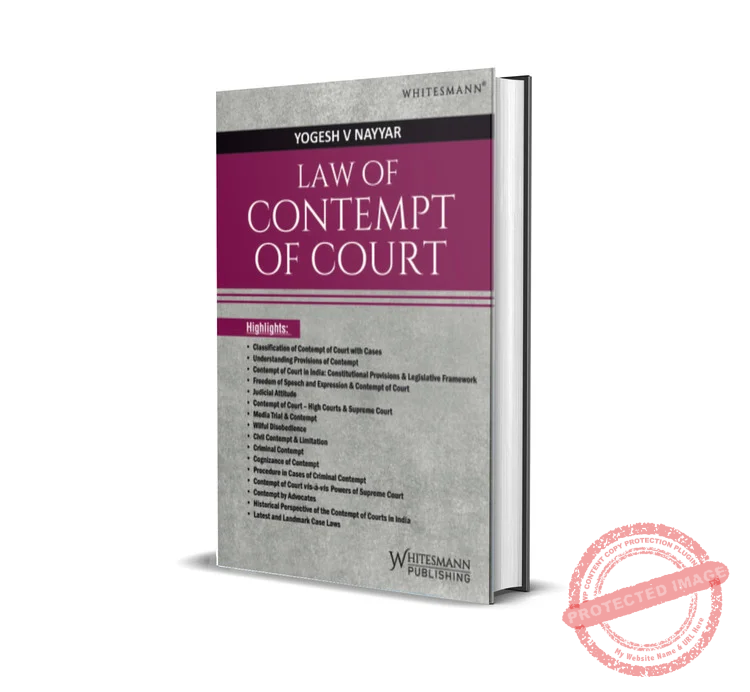
Yogesh V Nayyar’s Law of Contempt of Court
₹2,250.00 Original price was: ₹2,250.00.₹1,800.00Current price is: ₹1,800.00.
Author : Yogesh V Nayyar
Publisher : Whitesmann Publishing Company
ISBN NO : 978-9348904713
SKU : BCWMC00242
Edition : 2026
Format : Hardbound
HSN No : 49011010
Country Region : India
Estimated delivery:March 25, 2026
Description
Contempt of Court is an act of disobedience or disrespect towards the judicial branch of the government, or an interference with its orderly process. It is an offense against a court of justice or a person to whom the judicial functions of the sovereignty have been delegated.
The Contempt of Courts Act, 1971 categorises contempt into two types: Civil Contempt, which involves the willful disobedience of court orders, and Criminal Contempt, which includes actions that undermine the authority or dignity of the court.
The goal of contempt proceedings is to safeguard the public from disproportionate attacks on the court’s authority and the administration of justice, not to protect judges personally from criticism.
Under Section 2(b) of the Act of 1971, Civil contempt refers to willful disobedience to any judgment, decree, direction, order, or other processes of a court, whereas criminal contempt involves actions that scandalize or tend to scandalize, or lower or tend to lower the authority of any
court.
Sankaran Namboodripad v. T. Narayanan Nambiar, AIR 1970 SC 2095, observed: The law of contempt stems from the right of the courts to punish by imprisonment or fines persons guilty of words or acts which either obstruct or tend to obstruct the administration of justice.
Limitation for actions for contempt-No court shall initiate any proceedings of contempt, either on its own motion or otherwise, after the expiry of a period of one year from the date on which the contempt is alleged to have been committed.
Beside this article 225 of the Constitution of India makes provision for its continuity. Hence on the above grounds, it can be concluded that the contempt of court at 1971 is not violative of any provision of the Constitution and it is constitutionally valid.
Civil contempt refers to the willful disobedience of an order of any court. Criminal contempt includes any act or publication which: (i) ‘scandalises’ the court, or (ii) prejudices any judicial proceeding, or (iii) interferes with the administration of justice in any other manner.
Possible strategies include :
Claiming Unawareness: Arguing that you were unaware that your behavior was considered contemptuous could lead to a dismissal of charges.
Necessity or Self-Defense: Demonstrating that your actions were out of necessity or self-defense may lead to an acquittal.
Both civil and criminal contempt share the same punishment under the Contempt of Courts Act, 1971. The act allows for a maximum term of imprisonment for six months, and this can be supplemented with a fine of up to 2000.
The Book elucidates the subject on Classification of Contempt of Court with Cases, Understanding Provisions of Contempt, Contempt of Court in India: Constitutional Provisions &Legislative Framework, Freedom of Speech and Expression and Contempt of Court, Judicial Attitude, Contempt of Court – High Courts, Media trial & Contempt, Willful Disobedience, Civil Contempt & Limitation, Criminal Contempt, Cognizance of Contempt, Procedure in Cases of Criminal Contempt, Contempt of Court vis-a-vis Powers of Supreme Court, Contempt by Advocates and case laws delivered by the Hon’ble Supreme Court of India and High Courts.
Highlights :
Classification of Contempt of Court with Cases
Understanding Provisions of Contempt
Contempt of Court in India: Constitutional Provisions & Legislative Framework
Freedom of Speech and Expression & Contempt of Court
Judicial Attitude
Contempt of Court – High Courts & Supreme Court
Medla Trial & Contempt
Wilful Disobedience
Civil Contempt & Limitation
Criminal Contempt
Cognizance of Contempt
Procedure in Cases of Criminal Contempt
Contempt of Court vis-a-vis Powers of Supreme Court
Contempt by Advocates
Historical Perspective of the Contempt of Courts in India
Latest and Landmark Case Laws
27 people are viewing this product right now
Your Payment is 100% Secure
Be the first to review “Yogesh V Nayyar’s Law of Contempt of Court” Cancel reply
More
More



Reviews
There are no reviews yet.