
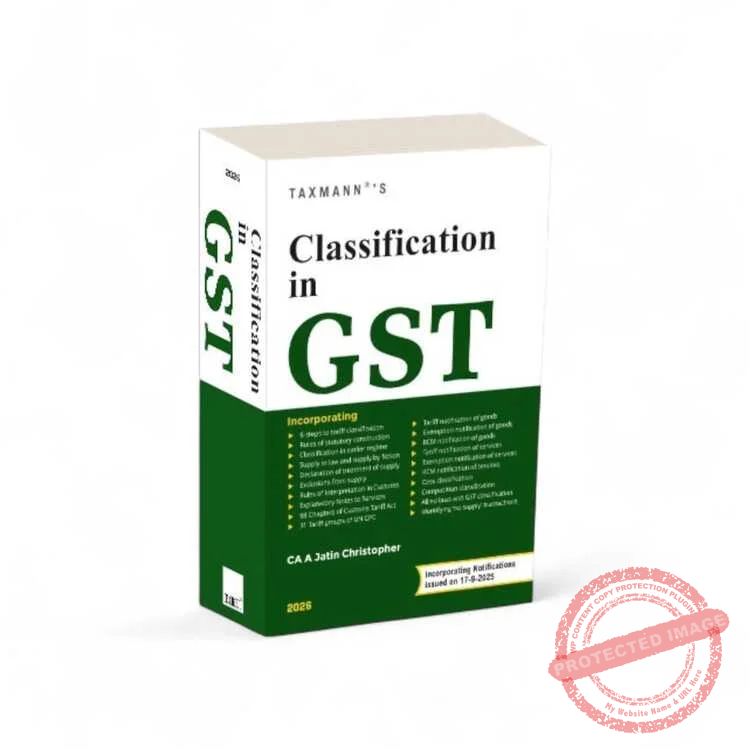
A Jatin Christopher’s Classification in GST
₹1,195.00 Original price was: ₹1,195.00.₹1,076.00Current price is: ₹1,076.00.
Author : A Jatin Christopher
Publisher : Taxmann
ISBN NO : 978-9371267946
SKU : BCTXM0021
Edition : 2026
Format : Paperback
Pages : 700
HSN No : 49011010
Description
Classification in GST is a specialised, practice-oriented commentary on the classification of supplies under GST, built on a rigorous, rule-based methodology rather than rate charts or ‘common sense’ shortcuts. It treats classification as a six-step legal exercise, starting from whether there is a supply at all, and moving through object identification, tariff mapping, exemptions, reverse charge, cess and composition. Leaning heavily on the Customs Tariff Act, HSN, and UN CPC, the book demonstrates how GST classification is not a matter of intuitive labelling but of strict legal taxonomy. It systematically dismantles casual approaches—such as ‘when in doubt, levy 18%’ or blindly relying on sales tax/VAT schedules, AIS/26AS, accounting heads, or packaging declarations—and replaces them with a coherent framework grounded in statute, rules of interpretation, allied laws, and judicial decisions.
This book is intended for the following audience:
Indirect Tax Practitioners, Consultants & Law Firms advising on GST rates, exemptions, composition schemes, RCM liability, valuation and ITC, and who need a defensible, structured way to determine ‘what is being supplied’ and ‘under which entry’
In-House Tax, Finance & Compliance Teams in sectors like manufacturing, trading, real estate, hospitality, e-commerce, financial services, infrastructure, education and healthcare, who must design and document classification positions that can withstand audits and investigations
Litigation Professionals & Counsel appearing before adjudicating authorities, appellate forums and courts, who require an integrated view of classification across GST, Customs, Excise, VAT, Contract law and Property law jurisprudence
Senior GST Officers & Departmental Teams engaged in issuing SCNs, adjudication, audit and policy-making, looking for principled and consistent ways to test taxpayers’ self-assessment
Advanced Students of GST, Researchers & Trainers who wish to understand classification as a jurisprudential subject, not a list of rates, including those designing internal training modules or advanced courses in GST
The Present Publication is the 2026 Edition and incorporates notifications issued on 17-09-2025, reflecting the law as amended up to 15-11-2025. It is one of the first works to digest the post-September 2025 restructuring of GST rate, exemption, and RCM notifications in a classification-centric manner. It is authored by CA. A Jatin Christopher, with the following noteworthy features:
[Six-Step Approach to Classification] The book develops and employs a six-step plan for tariff classification that is consistently applied throughout the work. This plan starts with:
Classifying the transaction as supply/no-supply
Identifying the object of supply (goods, services, immovable property, rights, obligations)
Tariff classification
Exemption classification
RCM classification
Cess/composition classification
This structure is repeatedly applied to practical situations, especially in complex models (e.g., e-commerce, JDAs, subscription-based services)
[Strong Foundation in Rules of Statutory Construction] A substantial part of the book explains how to read notifications and tariff entries, using:
Literal, golden and mischief rules
Ejusdem generis, noscitur a sociis, words of rank, rule of last antecedent
Internal aids (section and chapter notes, explanations, schedules)
External aids (allied laws, earlier enactments, law commission reports, policy background)
The limited and specific weight of circulars, AARs and FAQs, and when they cannot determine classification
[Supply, No-Supply & Object Classification Clearly De-linked] The book carefully separates:
Supply Classification – Reading sections 7, 8, Schedules I–III, section 23 and exclusions to understand whether a transaction is a supply at all
No-supply Classification – identifying transactions of partition, transmission, assignment, subrogation, escheat, forfeiture, destruction, sovereign functions, notified no-supplies, etc.
Object Classification – determining what is actually being supplied (goods, services, immovable property, rights, obligations, tolerance, refraining from an act, etc.), including borderline areas like development rights, digital assets, actionable claims and ‘intangible immovables’
[Deep Dive into Goods vs Services under GST] The book explains how:
Goods can be treated as services (and vice versa) depending on statute and notifications
Certain things that are ‘goods’ in commerce may not be goods in law (e.g., unidentifiable or non-movable items)
Services are to be classified under the UN CPC-based scheme (CPC 31 tariff groups) rather than HSN rules, and the Customs Rules of Interpretation must not be imported into service classification except where expressly permitted
[Full Exploitation of HSN, Customs Tariff & UN CPC]
Uses HSN Rules 1–6 and section/chapter notes to determine the classification of goods
Covers all 98 Chapters of the Customs Tariff Act from a GST perspective, indicating how GST tariff items depend on them
Explains UN CPC-based service classification, including key groups such as construction, trade, financial services, insurance, education, health, public administration, recreation, membership organisations, municipal and extraterritorial services
[Integrated Treatment of Tariff, Exemption, RCM, Cess & Composition] The book does not treat tariff, exemption, RCM, cess and composition in isolation; instead, it shows how each layer depends on, and can never override, the initial classification of the supply and object. It systematically analyses:
Tariff notifications for goods and services (entries, headings, schedules, residual entries)
Exemption notifications (including the new entries and restructuring from Sept 2025)
RCM notifications for goods and services, with discussion on immutability of liability and limits of interpretation
Compensation cess notification (goods and services)
Composition notification and its restricted class structure
[Contract-centric and Fact-intensive Approach] A significant strength of the book is its insistence on reading the actual contract and factual arrangement:
Contract title vs operative clauses
Distinction between motivation and consideration
Jointly developed assets, barter/exchange, sham and colourable devices
E-commerce models, aggregator arrangements, ‘buy-now pay-later’, subscription portals
How not to infer classification merely from accounting heads, AIS/26AS, TDS categories or bank narratives.
[Case Law and Allied Law Integration] The analysis interweaves leading decisions on:
‘Goods’, ‘deemed sale’, ‘manufacture’, ‘marketability’, ‘works contract’, ‘lease’, ‘business’, ‘State’, etc., from Customs, Excise, VAT and Constitutional law (e.g., Gannon Dunkerley and other landmark rulings)
Applicability of statutory concepts from the Contract Act, Transfer of Property Act, Easements, Income-tax Act, Legal Metrology and other allied laws, wherever GST leans on those expressions
[Practice-oriented Warnings & Correctives]
Throughout, the author confronts standard but flawed practices:
‘If in doubt, apply 18%’
Assuming concessional rates must be denied if not explained by the taxpayer, without first testing the entry
Treating everything appearing in income-tax or accounting records as taxable supply
Relying excessively on sales-tax/VAT-era rate schedules
The book is organised into 20 chapters, each dealing with a specific layer of classification. Illustratively:
Background
Why ‘common sense’ is unreliable; why classification is the pith of tax legislation; the six-step classification exercise; difference between tariff headings and tariff entries; role of substantive law (contract, property, etc.); commencement of business; implications of change in classification; affirmative actions; the limited role of AARs, circulars and Customs decisions; and the importance of ‘context-of-the-text’
Interpretation in Classification
Explores common, trade and expert parlance; how trade parlance can differ from consumer perception (e.g., tomato as botanically a fruit but commercially a vegetable); drafting errors and misprints; literal, golden and mischief rules; internal/external aids; and how to treat non-binding materials like FAQs and press notes
Classification within Contracts
Focuses on how contracts must be read to identify supply: title vs content, motivation vs consideration, performance conditions, performance risk, privity, sham contracts, jointly developed assets, unauthorised activities, fact patterns in e-commerce and digital platforms, and when contract terminology is misleading
Essentials of Classification
Separates supply classification, no-supply classification and object classification; addresses produce of cultivation; pure agency; subsidies and grants; transformation of goods into services (and vice versa); and how ‘information’ given by the taxpayer is treated as a fact, not a legal conclusion
Classification Override
Explains how law can substitute or override the contractual object (composite and mixed supplies, deemed goods/services), the role of residual entries, and how exemption and RCM provisions can only operate after classification is correctly fixed
Supply, Fiction, Treatment & Exclusions
Forms of supply (sale, transfer, barter, exchange, license, rental, lease, disposal); mutuality; import of services
Legal fictions in Schedule I (supplies between related/distinct persons, principal–agent, branches, etc.)
Schedule II (declaring certain activities as supply of goods or services)
Schedule III (no-supply items, including sovereign functions, employment, actionable claims, land and completed building, and retrospective inclusions/exclusions)
Classification Rules for Goods & Services
Detailed analysis of HSN Rules of Interpretation for goods; section and chapter notes; application and limits of these rules under GST
Introduction to UN CPC; how to use Explanatory Notes to the scheme of classification of services; coverage of all major groups, including construction, financial services, leases, R&D, education, health, public administration, club/association, cultural and extraterritorial services
Goods – Tariff, Exemption, RCM
Walkthrough of all 98 Customs Tariff Chapters and their GST relevance
Chapter-wise analysis of goods exemption notification, including new and restructured entries post 17-09-2025
Entry-wise reading of RCM notification for goods, highlighting how liability is shifted, the significance of the ‘supplier’ column, and constraints on creative reinterpretation
Services – Tariff, Exemption, RCM
Systematic classification of services under GST tariff entries (chapter 99), grouping 9954, 9961–9969, 9971–9973, 9981–9989, 9991–9999, etc.
Comprehensive coverage of services exemption notification, with attention to education, health, government functions, charitable activities, transportation, financial services, social welfare and export-related exemptions
Detailed examination of RCM notification for services, entry by entry, including special entries for online platforms, insurance, sponsorship, director services, renting, security services and others
Cess, Composition & No-Supply
Cess classification of goods (entries 1–56), the sub-set nature of cess HSN, residual entries and cess on services
Composition classification, including two-class structure (goods and services), treatment of restaurant/hospitality, thresholds and interaction with RCM and cess
Consolidated treatment of ‘no-supply’—purpose, statutory basis, examples, and practical consequences for GST compliance and litigation
Within these chapters, the author frequently uses tables, checklists, ‘touchpoint’ matrices (especially for e-commerce business models), examples and hypotheticals to illustrate how the six-step method works in practice
The structure is deliberately layered and iterative:
First Principles – Chapters 1–2 set the interpretative and conceptual foundations
Transaction & Contract Analysis – Chapters 3–5 make the reader understand how to correctly read contracts and facts before touching tariff schedules
Supply/No-Supply & Object Identification – Chapters 6–9 determine whether there is any supply in the first place and, if so, what exactly is being supplied
Tariff-level Detail – Chapters 10–17 move into granular tariff, exemption and RCM analysis for both goods and services, using HSN and UN CPC
Special Regimes & Exclusions – Chapters 18–20 complete the framework with cess, composition and no-supply
The book can thus be used in two ways:
Sequentially, as a deep study of classification in GST, and
Referentially, by dipping into specific chapters when a classification question arises in practice, using the contents, chapter-heads and lists of cases to navigate



Reviews
There are no reviews yet.