
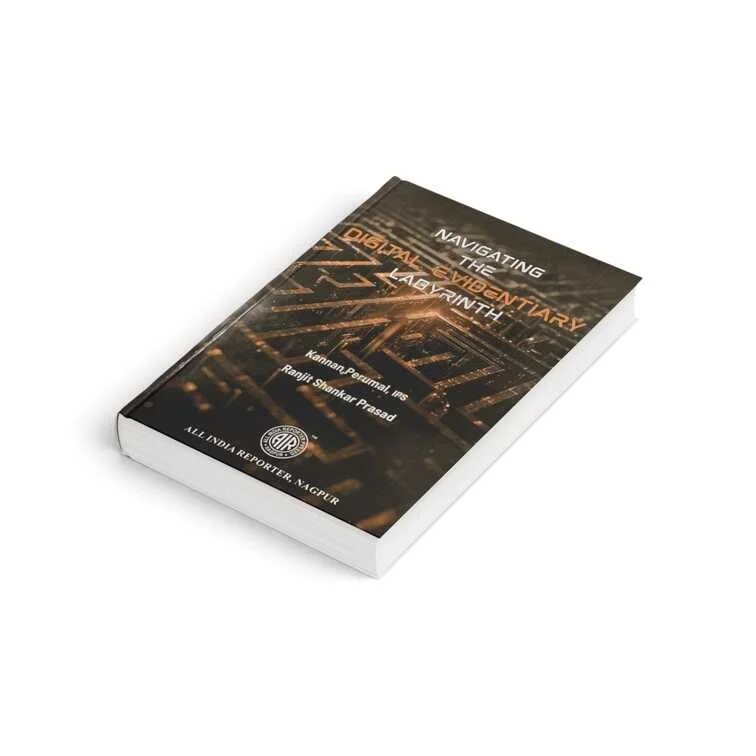
Navigating the Digital Evidentiary Labyrinth
₹1,295.00 Original price was: ₹1,295.00.₹1,294.00Current price is: ₹1,294.00.
Author : Kannan Perumal, IPS, and Ranjit Shankar Prasad
Publisher : All India Reporter
SKU : BCAIR0069
Edition : 2026
Format : Paperback
HSN No : 49011010
Country Region : India
Description
In an era where every digital footprint can decide a verdict, Section 63 of the BSA, 2023 has redrawn the contours of admissibility. This lifecycle-based commentary — co-authored by IPS officer Kannan Perumal and veteran legal practitioner Ranjit Shankar Prasad — guides police, prosecutors, defence counsel, and judges through seizure, chain of custody, BYOD dilemmas, expert testimony, and constitutional safeguards under Puttaswamy and Article 20(3). Anchored in Anvar P.V. and Arjun Panditrao Khotkar, it converts the BSA’s promise into practical discipline — an indispensable companion for the digital courtroom: rigorous, role-specific, and reform-ready.
The age of digital evidence is here — and with it, a quiet revolution in the law of proof.
Section 63 of the Bharatiya Sakshya Adhiniyam, 2023 reshapes the admissibility of electronic records, carrying forward the discipline established in Anvar P.V. v. P.K. Basheer (2014) and Arjun Panditrao Khotkar v. Kailash Kushanrao Gorantyal (2020). Yet statutory reform alone cannot guarantee justice. Whether digital evidence strengthens or destabilizes a case depends on how it is handled — at every stage of its life.
This work offers a lifecycle-based, practitioner-centric guide to electronic evidence under the new evidentiary regime. From seizure to tendering, it addresses the constitutional and procedural questions confronting the modern courtroom: BYOD dilemmas and Article 20(3); the Puttaswamy privacy framework; forensic imaging, hashing, and chain-of-custody discipline; the evolving scope of “computer output” across ephemeral messaging, IoT streams, and cloud logs; and the explanatory role of Section 63(4) certificates and Section 45 expert testimony.
Written for police officers, prosecutors, defence counsel, and judges, the book translates technological complexity into legally intelligible doctrine — rigorous, role-specific, and rooted in constitutional values.
Kannan Perumal, an officer of the Indian Police Service and alumnus of the International Anti-Corruption Academy, Vienna, brings two decades of investigative and anti-corruption experience. Ranjit Shankar Prasad, with thirty-five years of legal practice and a permanent faculty role at the Bihar Institute of Public Administration and Rural Development, contributes deep doctrinal expertise.
Together they deliver an indispensable companion for the digital courtroom — where bytes meet the bench, and the rule of law must remain constant.



Reviews
There are no reviews yet.